Tuesday, 27 February 2018
The Creative Cabo.
The Cabo to Gata seems to attract a lot of highly talented graffiti artists and there are many striking images to be found in the strangest places. This is especially true of Rodalquilar with its large number of ruined miner’s cottages and the strange deserted buildings of the old goldmine.
I’m often puzzled as to how the artists managed to decorate some of the harder to reach parts of the goldmine!
This area has inspired creativity for a long time. A great many films have been made around here, e.g. Lawrence of Arabia, Indiana Jones, as well as many westerns. Film buffs can follow the “rutas del cine” and see the places where various scenes were shot.
In Almeria city there is a statue to John Lennon who wrote his song “Strawberry Fields” while staying there when taking part in the making of the film, How I Won the War.
Friday, 23 February 2018
Sounds of the Cabo.
One of the most distinctive sounds of the Cabo de Gata is the ringing of goat bells. It is a haunting sound that carries a long way across the quiet valleys and hills and it always fills me with a strange, achingly painful happiness.
There are three herds of goats and sheep in this area so we come across them almost every day grazing by the roadsides, in the fields or on the hillsides, on the cliffs and the dunes by the seashore. Once it was terrifying when we were out on the cliffs and we saw two young billygoats headbutting each other on the edge of a sheer drop down on to the rocks below!
In this short video clip you can hear both goat bells and the blustery wind that is another common sound of the Cabo:
They are always accompanied by their shepherd and at least one dog - often
two. The shepherds live closely with
their animals. In Rodalquilar, there are
two shabby old houses on smallholdings, both with a goat shed standing right beside them where
the goats and sheep are penned at night.
The animals are kept for their milk which is turned into cheese – the land here
is too poor for dairy cattle so all the cheese comes from goats or sheep.
Other common sounds of the Cabo are the calling of the crested larks that we see everywhere in the countryside, the constant cooing of the collared doves flying about San José (I have seen as many as ten at a time roosting together on a rooftop), and the hypnotic sound of the sea.
Tuesday, 13 February 2018
ART IN THE EVERYDAY
Besides the professional artists, creativity can be found
everywhere in less formal ways, such as these painted gates in Rodalquilar:
And painted agave stalks:
Ephemeral art is constructed on the beaches, at Playa el Playazo:
And at Cala del Carnaje:
Wednesday, 7 February 2018
Art on the Cabo
The Cabo de Gata attracts a wide number of artists; painters, sculptors,
writers. The constantly changing light on both the land and the sea
provides never ending inspiration; the dazzling sunlight and vibrant colours
can change in an hour to an eery mist that turns the hills into the magical
landscape of a fairytale.
Here in San José our resident artist is Laura Quintana who has a studio near the port as well as one in Almeria. Originally from Madrid, she fell in love with the ever-changing light and colour of the Cabo and has lived and worked in the area for nine years.
Her work beautifully recreates the vivid seascape and landscape of the Cabo.
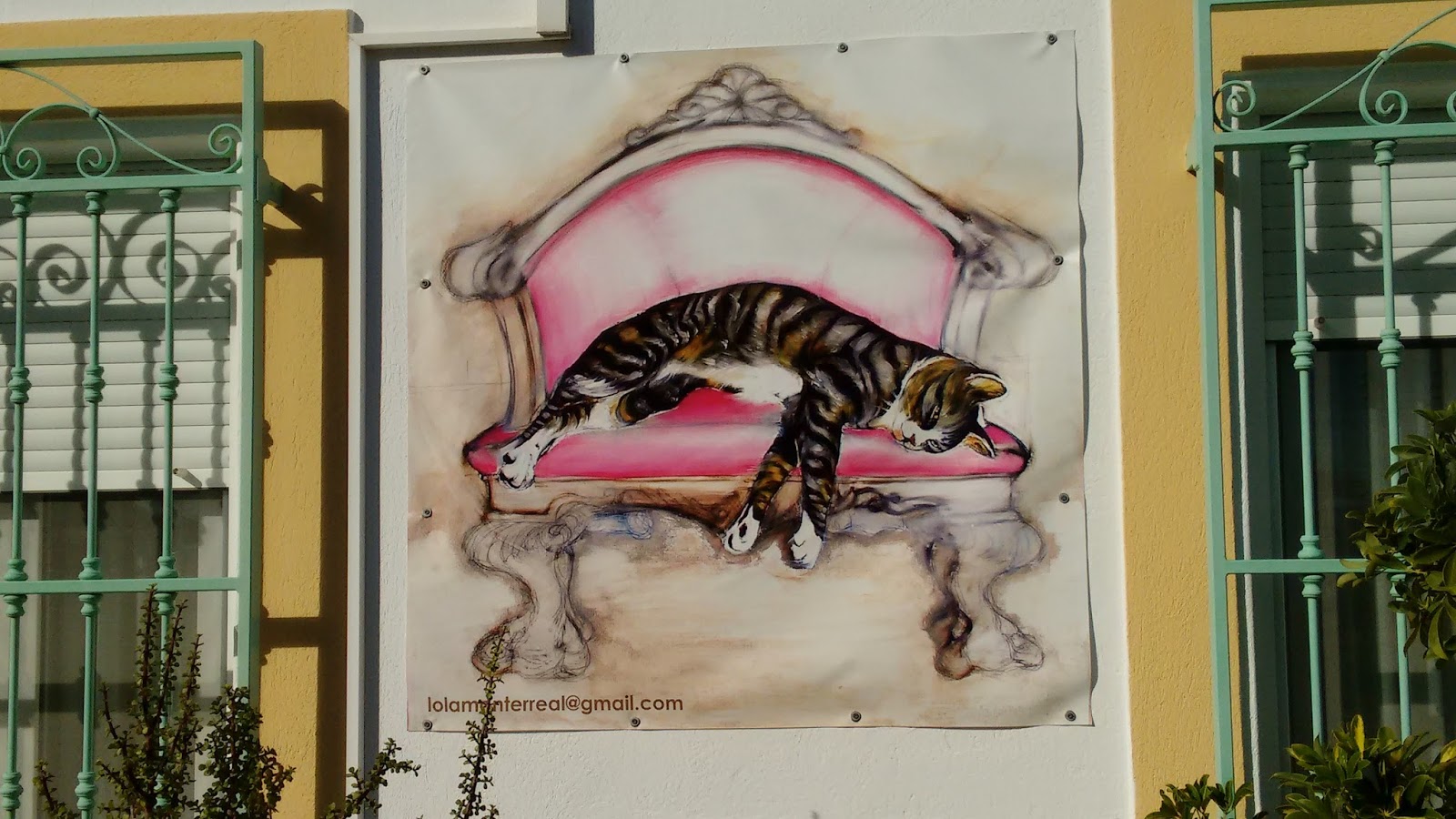
The village of Rodalquilar, where we stayed last year, has a number of resident artists and writers, and has transformed itself into a living art gallery, Rodalquilarte. This year a number of new works of art have been displayed on the walls of the houses and shops. This gorgeous cat is by Lola Monterreal.
The names of all the artists involved in Rodalquilarte:
Here are some more of my favourites:
Here in San José our resident artist is Laura Quintana who has a studio near the port as well as one in Almeria. Originally from Madrid, she fell in love with the ever-changing light and colour of the Cabo and has lived and worked in the area for nine years.
The village of Rodalquilar, where we stayed last year, has a number of resident artists and writers, and has transformed itself into a living art gallery, Rodalquilarte. This year a number of new works of art have been displayed on the walls of the houses and shops. This gorgeous cat is by Lola Monterreal.
Here are some more of my favourites:
Friday, 2 February 2018
BLACK REDSTART
One of the most common birds here is the black redstart, with a black head, dark grey back and wings, enlivened by a white stripe on the wings and a bright red tail. We see them everywhere in the countryside and there is one who visits the garden outside our house every morning. Here are some photos I took through the kitchen window:
I don't have any poetry for this bird in my booklet by Juan José Trujillo Reyes so I've written a couple of lines myself:
"in flight you flaunt your bright red petticoat with its white lace edging
that peeks beneath the black skirt of your wings as you pose upon the stone"
One of the most common birds here is the black redstart, with a black head, dark grey back and wings, enlivened by a white stripe on the wings and a bright red tail. We see them everywhere in the countryside and there is one who visits the garden outside our house every morning. Here are some photos I took through the kitchen window:
I don't have any poetry for this bird in my booklet by Juan José Trujillo Reyes so I've written a couple of lines myself:
"in flight you flaunt your bright red petticoat with its white lace edging
that peeks beneath the black skirt of your wings as you pose upon the stone"
Monday, 22 January 2018
Bird Poetry and Beach Flowers.
Flamingos in the lagoon at Las Salinas. The photo is taken from one of the bird hides with a mobile phone so you may need to use your imagination to make out the birds!
There are hundreds of birds here; it seems strange in the
middle of winter to hear bird song all around you. In the tourist information
office in San José I found a mini guide to the birds of the Cabo de Gata. It
is in Spanish which is excellent practice for my language skills! The
description of the birds are accompanied by lines of poetry, both written by
Juan José
Trujillo Reyes.
In strict translation they rarely work as poetry, but I have
tried translating some of the lines about the more common birds around here in
a way that I hope is reasonably successful.
We see Crested Larks everywhere, making their
curving flight across the land, and Alpine Swifts circle around the rocks
above, hunting insects.
Of the crested larks, Juan José Trujillo
Reyes says:
“Con su moño y grácil movimiento...
...alegria del campo árido”
(With his topknot and graceful flight...
...he brings joy to the arid land)
We have seen Little Terns diving like arrows
straight from the sky, dropping into the sea then rising again to swoop above
the waves, searching for fish with their bright observant eyes. Juan José Trujillo Reyes describes them:
“A la playa no le llaméis exilio...
...no es campo de refugiados, es refugio”
(To you, the shore is no exile ...
...it’s not a refugee camp, it’s a refuge)
In the village, white wagtails hop about the roads
and collared doves whirr about the house with their hypnotic cooing cry.
Juan José describes the wagtails:
“Su reflejo en el agua ...límite de su sueño”
(His reflection in the water ...his dreams go no
further)
Everywhere, it appears, in the countryside around
San José there are Stonechats, Black Redstarts and Wheatears, as well as Eagles
hunting in the valleys and hills of the National Park.
The Stonechat:
“Desteca en el horizonte ...
...su silueta de centinela”
(Against the horizon ...
...his silhouette stands sentinel)
Flamingos pick their way through the salt marshes
at Las Salinas, lifting their knees high, their beaks trained on the water
beneath. Juan José says of them:
“Líneas rosas que vuelan...
...leyenda del Fénix flameando los cielos”
(Flying crimson streamers...
...legend of the Phoenix flaming the skies)
Last week we had some miserable weather, a couple of very
grey chilly days and rain all one night and the best part of the next
day. But now the weather has turned glorious once again!
The advantage of
the rain is that all the wildflowers have suddenly burst into bloom, almost
overnight. I found these Bermuda buttercups actually growing among the pebbles
on the beach at Cala del Carnaje.
And these exquisite sand crocuses were growing on the edge
of the beach at Playa de los Genoveses where they stud the sand dunes like stars.
Subscribe to:
Posts (Atom)